the party of tourists
The party of tourists appears only in the final pages of The Old Man and the Sea, yet their brief, oblivious presence delivers the novel's most pointed commentary on the relationship between heroic suffering and public perception. Arriving at the Terrace after Santiago has returned with only the skeleton of his great marlin, the tourists gaze down at the remains and, in their ignorance, mistake the magnificent fish for a common shark, completing a narrative arc that moves from the old man's intimate, dignified struggle to the reductive, commodifying gaze of the world.
Arrival and the Scene at the Terrace
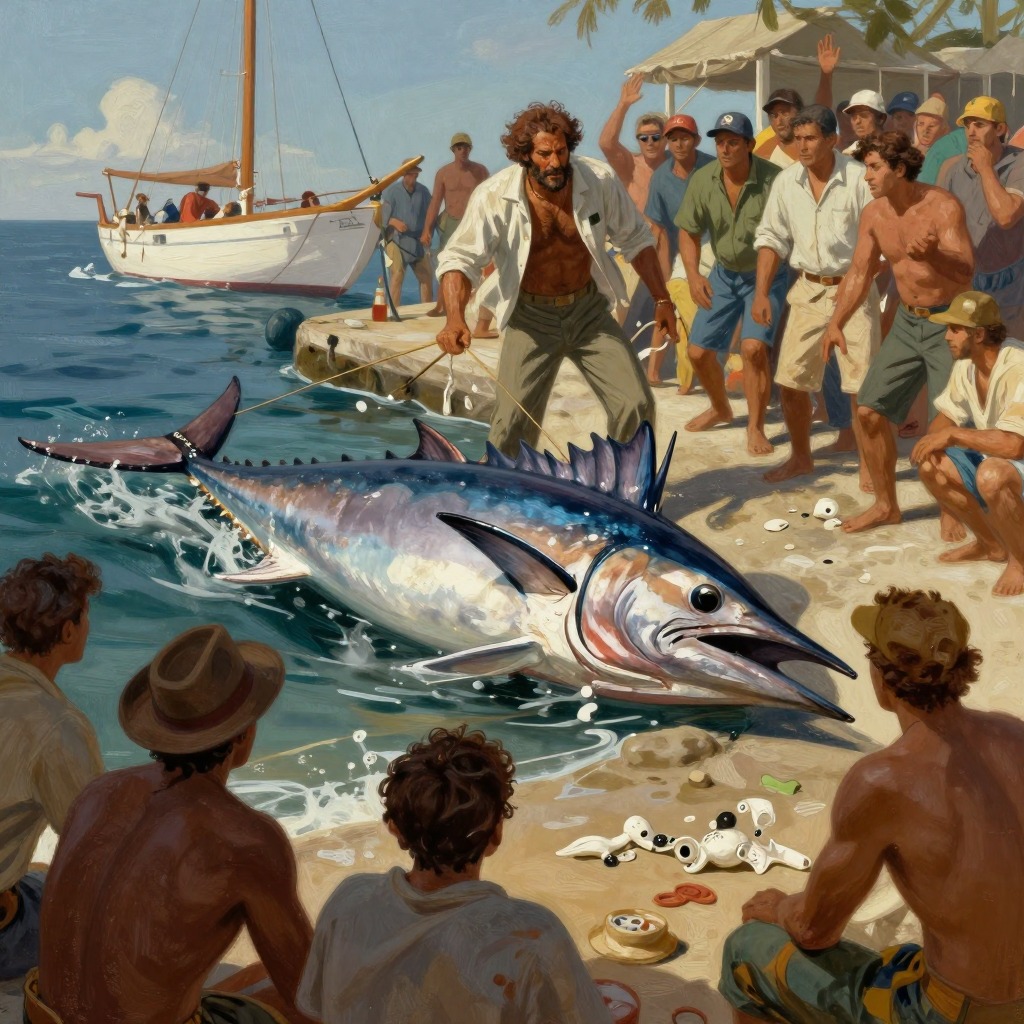
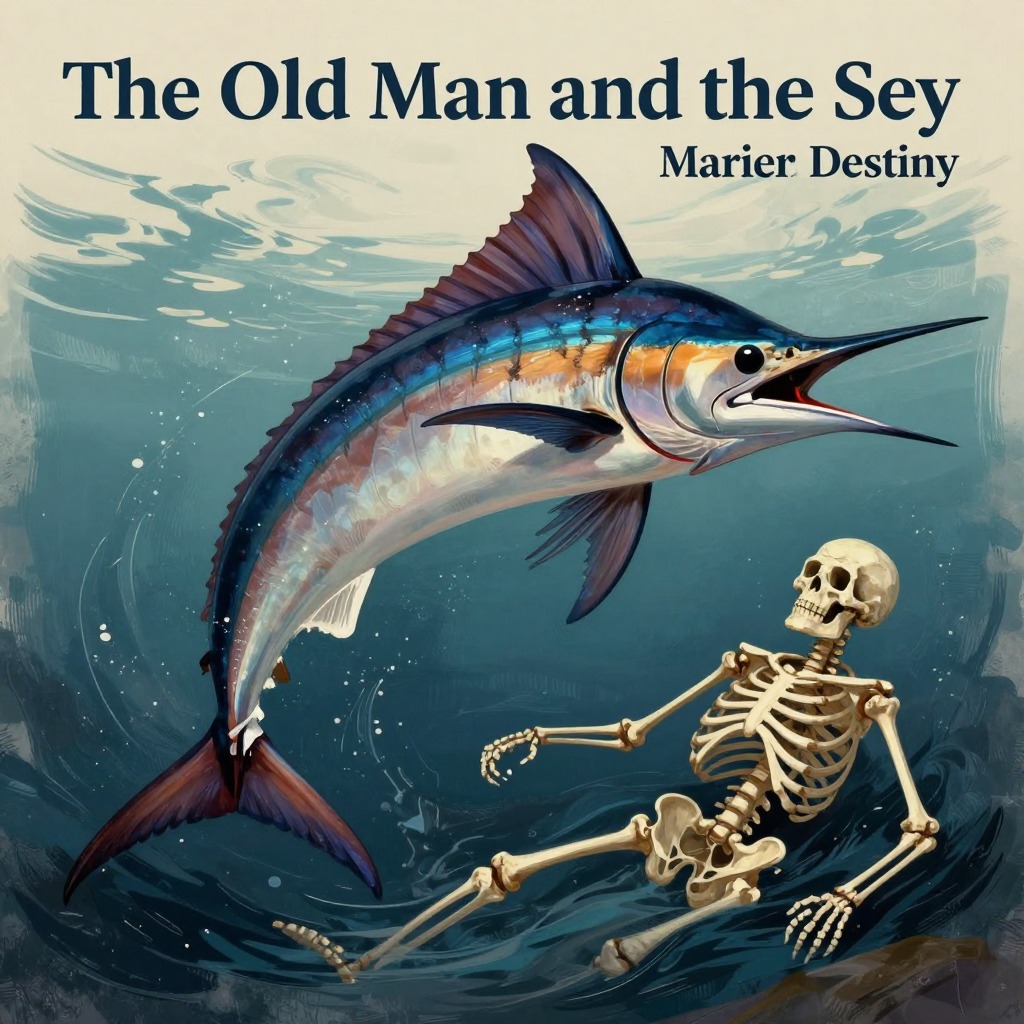
That afternoon, after Santiago has slept and the boy Manolin has wept over his ruined hands, a party of tourists comes to the Terrace. They look down into the water among the empty beer cans and dead barracudas, where the east wind blows a heavy steady sea outside the entrance to the little harbour. There, a woman sees a great long white spine with a huge tail at the end that lifts and swings with the tide. Pointing to the long backbone of the great fish—now just garbage waiting to go out with the tide—she asks a waiter, "What's that?" The waiter, meaning to explain what had happened, answers simply, "Tiburon. Shark." The woman, impressed, replies, "I didn't know sharks had such handsome, beautifully formed tails," and her male companion echoes, "I didn't either." Their exchange is the novel's final spoken dialogue, and it seals the fate of Santiago's triumph: the evidence of his greatest catch is misread as a curiosity of a predator.
The Misidentification and Its Irony
The tourists' error is not merely a mistake of fact; it is a profound failure of perception. The skeleton they admire—eighteen feet from nose to tail, as the fisherman who measured it confirmed—is the remains of the marlin Santiago fought for three days, a fish he came to call his brother, a creature of such beauty and nobility that he thought no one was worthy of eating him. The waiter's single word, "Shark," collapses this entire epic into a banal category. The tourists see a handsome tail and a long spine, but they see no story, no struggle, no old man who lost his harpoon and his knife and nearly his life to bring it in. They see only an object, a spectacle, a piece of marine debris. This moment echoes the novel's earlier, more hopeful scenes of community—the fishermen on the Terrace who spoke politely about the current and the depths, the proprietor Martin who sent food and beer, the boy who cried for Santiago—and replaces them with a detached, consumerist gaze.
Contrast with the Fishermen's World
The tourists stand in stark opposition to the fishing community that surrounds Santiago. Earlier, the successful fishermen had butchered their marlin and carried them to the fish house, while those who had caught sharks took them to the shark factory on the other side of the cove. The old man himself had calculated the marlin's market value—over fifteen hundred pounds, perhaps dressing out at thirty cents a pound—and thought that the great DiMaggio would be proud of him. But the tourists have no connection to this economy of labor, skill, and risk. They are outsiders, and their presence at the Terrace, looking down at the water among the empty beer cans, underscores how Santiago's private ordeal has no public monument. The skeleton will be chopped up by Pedrico for fish traps; the spear, the marlin's bill, the boy will keep. The tourists' misreading is the final, ironic reduction of a transcendent experience to a tourist's anecdote.
Thematic Significance: The Gap Between Experience and Report
The party of tourists crystallizes a central theme of the novel: the impossibility of fully communicating profound personal experience to those who have not shared it. Santiago himself, throughout his ordeal, had spoken aloud to himself, to the fish, to the birds, and had wished for the boy to see what he was seeing. But the boy, who loved him and understood, was not there for the fight. The tourists, who were there only for the aftermath, cannot even identify what they see. The old man, meanwhile, is not present for this final scene; he is sleeping again in his shack, dreaming of the lions on the beach. His dream—of Africa, of the long golden beaches, of the lions playing like young cats in the dusk—is the novel's true ending, a return to the private, interior world of memory and imagination that no tourist can ever reach. The party of tourists, in their cheerful ignorance, are the final proof that a man can be destroyed but not defeated, and that the world will never know the difference.